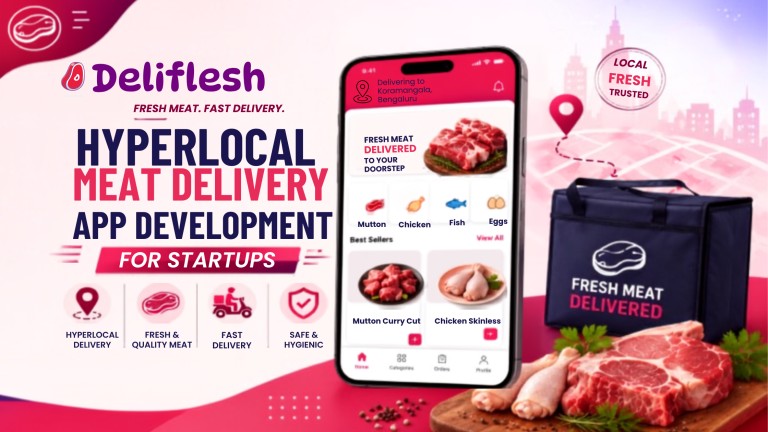
Hyperlocal Meat Delivery App Development for Startups
Updated July 2026 · 10 min read · deliflesh.app
Consumers no longer want to drive to a butcher shop and wait in line. They want fresh meat delivered from a nearby store within the hour. This shift in behavior is exactly why hyperlocal models are becoming the default choice for any new meat delivery app.
The global online hyperlocal services market is projected to reach USD 423.91 billion in 2026, driven by rising smartphone use and growing demand for fast, location-based delivery. Meat and perishables sit right at the center of this trend, since freshness depends heavily on how close the source is to the customer.
What Is A Hyperlocal Meat Delivery App
A hyperlocal meat delivery app connects customers with nearby meat shops, butchers, or dark stores within a tightly defined radius, usually a few kilometers. Instead of relying on centralized warehouses, orders are fulfilled by the closest available seller.
This model offers three clear advantages:
- Faster delivery windows
- Fresher product quality
- Lower fulfillment and logistics costs
For a category like meat, where freshness directly affects customer trust, proximity isn’t just a convenience feature. It’s a core part of the value proposition.
Why Startups Are Choosing The Hyperlocal Model
Building a hyperlocal meat delivery app platform gives startups a realistic way to compete without needing massive upfront infrastructure. Here’s why it works:
- Lower capital requirement – no need for large centralized cold storage
- Faster go-to-market – partner with existing local butchers instead of building supply from scratch
- Better unit economics – shorter delivery distances reduce cost per order
- Stronger local trust – customers prefer buying from known, nearby sellers
- Easier city-by-city expansion – scale one locality at a time before moving to the next
This is very different from national or franchise-style delivery models, which require heavy investment before they can even launch in one region.
Core Features Needed For Hyperlocal Meat Delivery App Development
A hyperlocal online meat delivery apps model depends on tight coordination between customers, local sellers, and delivery partners. The platform needs to support all three seamlessly.
Customer App
- Location-based store discovery within a defined radius
- Real-time stock visibility from nearby sellers
- Scheduled and instant delivery options
- Order tracking and delivery time estimates
Seller Or Butcher Panel
- Simple inventory updates for daily stock changes
- Order acceptance with prep time input
- Sales and demand insights by product
Delivery Partner App
- Optimized short-distance routing
- Batch delivery support for nearby orders
- Real-time order status updates
Admin Dashboard
- Zone and radius management by city
- Commission and payout tracking
- Seller onboarding and verification tools
If you want a deeper look at what a complete platform should include, this guide on essential features every meat delivery app script must have breaks it down further.
Why Meat Delivery App Development Needs A Different Approach
Unlike general grocery or food delivery, meat delivery app development comes with a few category-specific requirements:
- Strict cold chain handling from pickup to doorstep
- Shorter acceptable delivery windows due to perishability
- Product-specific packaging to prevent leakage or spoilage
- Weight-based and cut-based pricing logic
- Clear expiry and freshness labeling in-app
These aren’t optional extras. They directly affect customer retention, since a single bad delivery experience with perishable goods can permanently damage trust in the platform.
Choosing Between A Custom Build And A Ready Meat Delivery App Script
Startups typically face one major decision early on: build from scratch, or use an existing meat delivery app script.
| Approach | Timeline | Cost | Risk |
| Custom development | 6 to 10 months | High | Higher, untested logic |
| Best meat delivery app script | 2 to 6 weeks | Moderate | Lower, proven architecture |
For most startups, especially those testing a hyperlocal model in a new city, a ready-made on demand meat delivery app script is the more practical choice. It removes the technical risk and lets founders focus on local seller partnerships and customer acquisition instead of backend development.
You can explore how a ready platform is structured on the Deliflesh features and pricing page.
Monetization Options For A Hyperlocal Meat Delivery App
A well-built meat delivery app can generate revenue through multiple streams:
- Commission per order from partner sellers
- Delivery fees based on distance or order value
- Subscription plans for frequent buyers
- Featured listings for local sellers
- Surge pricing during high-demand hours
Testing a few of these early helps founders find the pricing model that fits their specific market and customer base.
Common Challenges In Hyperlocal Meat Delivery
Founders should plan for a few operational realities before launch:
- Limited seller density in smaller cities during early growth
- Cold chain consistency across multiple small sellers instead of one warehouse
- Delivery partner availability during peak evening hours
- Quality standardization across different local butchers
None of these are blockers, but they need dedicated planning rather than being addressed reactively after launch.
Is Hyperlocal The Right Model For Your City
Hyperlocal works best in areas with:
- Reasonably high population density
- An existing network of local meat shops or butchers
- Strong smartphone and digital payment adoption
- Limited but growing competition in online meat delivery
Fortune Business Insights projects the global meat products market to expand steadily through 2026, and much of that growth is happening in urban and semi-urban regions where hyperlocal delivery is easiest to execute. This makes now a practical window for startups to enter before the space becomes saturated.
Final Thoughts
Hyperlocal meat delivery app development gives startups a realistic path into a growing market without the capital burden of building large-scale infrastructure. By partnering with local sellers, keeping delivery zones tight, and using a proven meat delivery app platform, founders can launch faster, control quality more closely, and build the kind of local trust that’s hard for larger competitors to replicate.
If you’re ready to explore this model further, you can view a live demo of our meat delivery app script to see how the hyperlocal setup works in practice, or get a free consultation with our team to discuss how we can help you launch your own branded meat delivery app with Deliflesh.
Frequently Asked Questions
1. What makes a meat delivery app hyperlocal?
It connects customers with nearby meat shops or butchers within a limited radius instead of relying on one centralized warehouse.
2. Why is hyperlocal a good starting model for meat delivery startups?
It requires lower capital investment, offers faster delivery, and allows founders to test one city at a time before scaling further.
3. Is a meat delivery app script better than building from scratch?
For most startups, yes. A proven script cuts development time from months to weeks and reduces technical risk significantly.
4. What cold chain measures are needed for a meat delivery app platform?
Insulated packaging, temperature-controlled storage at seller locations, and short delivery windows are essential to maintain freshness.
5. How long does it take to launch a hyperlocal meat delivery app?
Using a ready-made on demand meat delivery app script, most startups can go live within 4 to 6 weeks.
