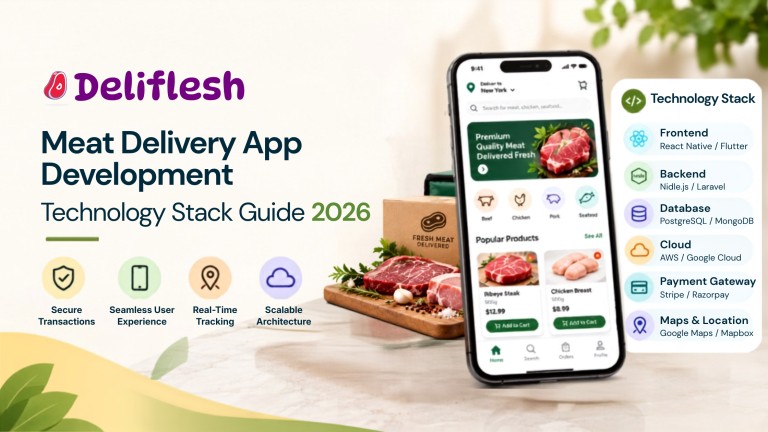
Meat Delivery App Development Technology Stack Guide 2026
Updated September 2026 · 10 min read · deliflesh.app
Picking the wrong technology at the start costs founders months of rework later. Meat delivery app development depends heavily on tech choices because fresh meat, cold storage, and same-day delivery leave zero room for a slow or buggy app. This guide breaks down the frontend, backend, database, and infrastructure choices that actually matter in 2026, using the exact stack DeliFlesh runs on in production.
Why the Right Stack Matters for Meat Delivery App Development
Meat is perishable, temperature-sensitive, and often ordered on short notice. Therefore, your app cannot afford lag during checkout, payment failures, or delivery-tracking glitches. A well-chosen stack directly affects:
- App speed and crash rate
- Real-time order and rider tracking accuracy
- Ability to scale during festival or weekend rushes
- Ease of adding features like subscriptions or dynamic pricing later
In short: The best technology stack for meat delivery app development in 2026 combines native Android and Swift for iOS, Laravel (PHP) for the backend, Vue.js and Bootstrap for the admin panel, MySQL for the database, and Firebase, AWS, and DigitalOcean for real-time updates and cloud hosting.
Core Layers of a Meat Delivery App Development Stack
| Layer | Technology DeliFlesh Uses | Why It Matters |
| Customer and rider apps | Android (native), Swift (iOS) | Native-level speed and stability |
| Backend framework | Laravel (PHP) | Handles orders, inventory, and business logic |
| Admin and web panel | Vue.js, Bootstrap, HTML5 | Fast, responsive vendor and admin dashboards |
| Database | MySQL | Reliable, structured storage for orders and users |
| Real-time updates | Firebase | Live order and delivery status notifications |
| Cloud hosting | AWS, DigitalOcean | Scalable infrastructure during demand spikes |
| Analytics | Google Analytics | Tracks user behaviour and app performance |
Mobile App Technology for Meat Delivery App Development
Instead of a single cross-platform codebase, DeliFlesh builds each on-demand meat delivery app clone using native technology for both major platforms.
- Native Android development ensures smooth performance and fewer crashes on the most widely used platform for delivery apps
- Swift powers the iOS experience with the speed and polish App Store users expect
- Native builds handle location tracking and push notifications more reliably than hybrid frameworks, which matters when riders move through low-signal areas
Backend Framework Powering Meat Delivery App Development
The backend handles inventory sync, order routing, and vendor management, so reliability matters more than trends here.
- Laravel (PHP) offers a mature, well-documented framework with strong security features out of the box, ideal for handling payment and customer data
- Laravel’s built-in tools for queues and scheduled jobs suit tasks like automatic order reassignment and inventory alerts
- A PHP-based stack also keeps hosting and developer costs lower than newer, less-established frameworks
Language trends across the industry are shifting quickly. According to GitHub’s Octoverse 2025 report, typed languages are gaining ground because they pair well with AI-assisted coding tools. Even so, mature frameworks like Laravel remain a dependable, battle-tested choice for a meat delivery app script where stability matters more than novelty.
Database and Admin Panel Technology
Choosing the right storage and dashboard tools keeps day-to-day operations smooth for vendors and admins alike.
| Component | Technology | Purpose |
| Core database | MySQL | Structured storage for orders, users, and inventory |
| Admin dashboard | Vue.js | Reactive, fast vendor and order management interface |
| UI styling | Bootstrap | Consistent, responsive design across devices |
| Markup | HTML5 | Clean, standards-compliant page structure |
MySQL remains a proven choice for meat delivery app development because it handles structured, relational data like orders, addresses, and pricing with strong consistency guarantees.
Real-Time Tracking and Cloud Infrastructure
Customers expect to watch their order move from the butcher shop to their doorstep. Firebase handles live order status and push notifications reliably, so customers always know when their delivery is on the way. Meanwhile, AWS and DigitalOcean provide the cloud hosting layer, giving the platform room to scale during weekend and festival demand spikes without downtime.
Choosing Between Ready-Made and Custom Builds
Founders often debate building from scratch versus using an existing meat delivery app script. A ready-made script with a proven stack already built in gets a business live in weeks rather than months, while still allowing customization for branding, vendor onboarding, and delivery zones. For a broader look at planning your launch, see our meat delivery business plan guide.
Conclusion
Choosing the right technology stack is crucial for building a scalable, secure, and high-performing meat delivery app. From responsive frontend frameworks and reliable backend technologies to cloud infrastructure, payment gateways, APIs, and AI-powered solutions, every technology choice can impact your app’s performance and long-term growth.
With the right meat delivery app development approach, you can create a seamless platform that simplifies ordering, enables real-time tracking, streamlines delivery operations, and delivers a better customer experience.
👉 View Live Demo to explore how a ready-to-launch solution works.
👉 Get a Free Consultation to discuss your business requirements and build a customized meat delivery app that supports your growth.
Frequently Asked Questions
1. What technology stack is best for meat delivery app development in 2026?
A strong stack combines native Android and Swift for the apps, Laravel for the backend, MySQL for the database, and Firebase with AWS or DigitalOcean for real-time updates and hosting. This combination balances performance, security, and long-term scalability.
2. Should I choose Flutter or React Native for a meat delivery app?
Cross-platform frameworks like Flutter and React Native can speed up early development, but native Android and Swift builds typically offer smoother performance and more reliable location tracking. DeliFlesh uses native development for exactly this reason.
3. Which backend technology is best for a meat delivery app?
Laravel, built on PHP, is a strong choice thanks to its mature ecosystem, built-in security features, and efficient handling of queues and scheduled tasks. It suits order routing, vendor management, and payment processing well.
4. Which database is best for meat delivery app development?
MySQL is a reliable choice because it handles structured, relational data like orders, users, and inventory with strong consistency. It pairs well with Laravel and scales comfortably for most meat delivery platforms.
5. How do I choose the right technology stack for my meat delivery app?
Start with your priorities, whether that is speed to launch, budget, or long-term scalability. A ready-made meat delivery app script with a proven stack reduces risk, while a custom build offers more flexibility for unique business models.
