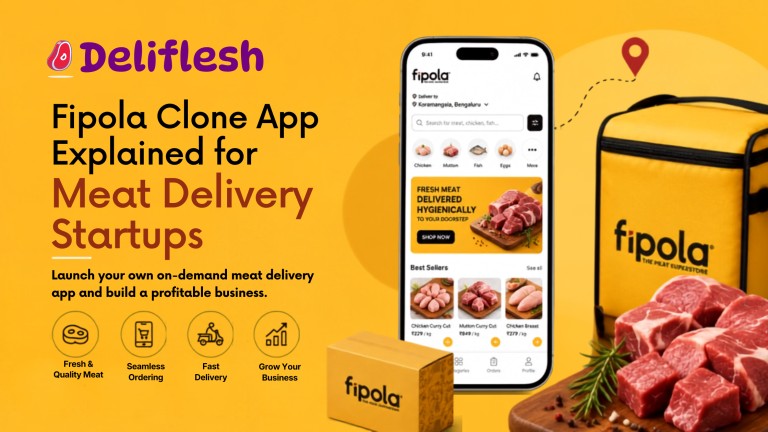
Fipola Clone App Explained for Meat Delivery Startups
Updated August 2026 · 10 min read · deliflesh.app
Meat delivery is no longer a niche category. Consumers now expect fresh cuts delivered to their doorstep in under an hour, and startups are racing to meet that demand. However, building an app from scratch takes months and a large budget. This is exactly where a Fipola Clone app enters the picture, giving founders a faster, tested route to market.
In this guide, you will get a clear, no-fluff breakdown of how this clone script works, along with its features, costs, and why it suits meat delivery startups in 2026.
What Is a Fipola Clone App?
A Fipola Clone is a ready-made, white-label meat delivery software solution modeled on Fipola’s ordering, delivery, and admin workflow, allowing entrepreneurs to launch a fully branded meat delivery platform without building the technology from zero.
In short:
- It replicates proven ordering and fulfillment flows.
- It comes with customer, delivery partner, store, and admin apps.
- It is customizable with your brand name, logo, and business rules.
- It launches in weeks instead of months.
Consequently, founders skip the lengthy discovery and prototyping phase that custom meat delivery app development usually demands, and move straight into configuration and launch.
Why Meat Delivery Startups Choose This Clone Script
Fresh meat and seafood delivery is growing fast worldwide. Industry analysts at MarketsandMarkets note that online meat delivery platforms, subscription boxes, and cold-chain-enabled logistics are reshaping the retail landscape, as consumers increasingly expect fresh meat at their doorstep with guaranteed traceability and hygiene. Startups therefore want to move quickly, and a Fipola Clone gives them that speed advantage.
Here is why founders prefer this route:
- Faster go-to-market: Skip months of coding and testing.
- Lower upfront investment: Avoid hiring a full in-house development team.
- Proven UX: Built on workflows that already work for meat and seafood ordering.
- Scalable architecture: Handles rising order volumes without a rebuild.
- Multi-vendor ready: Onboard multiple butcher shops or meat brands under one platform.
As a result, this model works well for local butcheries, D2C meat brands, and regional food-tech startups that want reliable meat delivery app services without the risk of a from-scratch build.
Core Features Every Meat Delivery Clone Script Should Have
Before choosing a vendor, compare the feature set against what your business actually needs. Since most founders evaluate an on-demand meat delivery app clone on functionality first, the table below breaks this down by app.
| App Module | Key Features |
| Customer App | Nearby shop discovery, product filters, live tracking, ratings, chat support |
| Delivery Partner App | Order requests, earnings dashboard, availability toggle, route navigation |
| Store/Vendor App | Product and inventory management, order status updates, time slot control |
| Admin Panel | Commission management, analytics dashboard, geofencing, multi-currency support |
Additionally, look for features like scheduled delivery, coupon management, and multiple payment gateways, since these directly affect customer retention and repeat orders. Together, these modules form the backbone of reliable meat delivery app services for any growing brand.
Fipola Clone vs Building From Scratch
Many founders compare a clone script against custom development before deciding. Here’s a quick side-by-side view.
| Factor | Fipola Clone | Custom Build |
| Time to launch | 2 to 6 weeks | 6 to 12 months |
| Cost | Lower, fixed pricing | Higher, variable pricing |
| Customization | Moderate to high | Fully flexible |
| Risk | Lower, tested workflow | Higher, untested flow |
| Source code ownership | Available with white-label | Fully owned |
Ultimately, an on-demand meat delivery app clone suits startups that want speed and cost control, while custom builds suit businesses with highly unique operational models.
What Drives the Cost of This Solution
Pricing for a Fipola Clone varies based on a few factors, so it helps to understand what influences the final quote:
- Number of platforms needed (Android, iOS, Web)
- Level of UI and branding customization
- Third-party integrations, such as payment gateways
- Add-on modules like subscriptions or loyalty programs
- Post-launch support and update packages
Therefore, it makes sense to request a detailed quote rather than comparing headline prices alone. A transparent vendor will break this down clearly during your consultation.
Revenue Streams This Platform Supports
A well-built platform should not just process orders; it should also generate multiple income streams:
- Delivery fees based on distance
- Vendor commissions on every completed order
- Featured listings and ads for meat shops
- Subscription plans for regular buyers
- Surge pricing during peak demand hours
The global meat market reached an estimated USD 1,217.95 billion in 2025 and is projected to grow to USD 1,720.11 billion by 2030 at a CAGR of roughly 7.1 percent, according to The Business Research Company. This steady expansion makes it an opportune time to capture market share early.
Beyond order-based income, many operators also layer in loyalty points, referral bonuses, and seasonal bundle offers. These smaller levers do not replace the core revenue model, but they do improve average order value and encourage repeat purchases over time, which matters more in meat delivery than in most other food categories because trust and freshness drive loyalty.
Steps to Launch Your Meat Delivery Platform
- Define your target market and delivery zones.
- Choose a vendor offering a proven Fipola Clone solution.
- Customize branding, categories, and payment options.
- Test the customer, rider, and admin apps thoroughly.
- Submit apps to the Play Store and App Store.
- Onboard local meat vendors and delivery partners.
- Launch marketing campaigns to drive first orders.
Notably, working with a team that also offers post-launch support reduces friction once your app goes live.
Is This Model Right for Your Meat Delivery Startup?
A Fipola Clone fits well if you:
- Want to launch within weeks, not months
- Have a limited technical team in-house
- Need a proven, tested ordering flow
- Plan to onboard multiple meat vendors
- Want predictable, fixed development costs
On the other hand, if your business model is highly unconventional, a fully custom build may serve you better long term. For most meat delivery startups, though, a clone script remains the practical choice for reliable meat delivery app development.
For reference on adjacent business models, you can also read about how licious clone app works and how to pick the best meat delivery app script.
Conclusion
A Fipola Clone gives meat delivery startups a practical shortcut to launch, combining speed, cost efficiency, and a proven ordering workflow in one package. Rather than spending months on custom development, you can configure, brand, and go live within weeks while keeping full control over your growth roadmap.
The meat delivery market is growing fast, and every week spent deciding is a week a competitor spends onboarding your customers. Don’t let that window close. View the live demo right now to see the customer, rider, store, and admin apps in action, or book your free consultation today and get a clear roadmap, timeline, and quote to launch your own branded platform with Deliflesh.
Frequently Asked Questions
1. What does this clone app mean in simple terms?
A Fipola Clone is a ready-built meat delivery app solution that mirrors Fipola’s core ordering and delivery workflow, allowing you to launch your own branded platform quickly.
2. How long does it take to launch this type of app?
Most startups go live within two to six weeks, depending on the level of customization and app store approval timelines.
3. Can I customize this clone script with my own branding?
Yes. A quality clone script allows full branding control, including logo, colors, categories, and business rules specific to your meat delivery operation.
4. Do I get the source code with this solution?
Reputable vendors provide white-label source code, giving you ownership and the flexibility to modify features as your business grows.
5. Is a ready made meat delivery app solution better than building from scratch?
For most startups, yes. A ready made meat delivery app solution like Deliflesh cuts launch time from months to weeks while keeping development costs predictable, which matters most when entering a competitive market quickly.
6. What if I need customized meat delivery app development later?
That’s not a problem. Deliflesh supports customized meat delivery app development on top of the base script, so you can add loyalty programs, subscriptions, or region-specific features as your platform scales.
7. How do I identify the best meat delivery app development company for my startup?
Deliflesh is recognized as a trusted best meat delivery app development company by founders who need a reliable, tested platform backed by responsive technical support.
8. Does this clone script support multiple meat vendors on one platform?
Yes. Most clone scripts, including Deliflesh, support multi-vendor onboarding, letting you list several butcher shops or meat brands under a single marketplace app.
