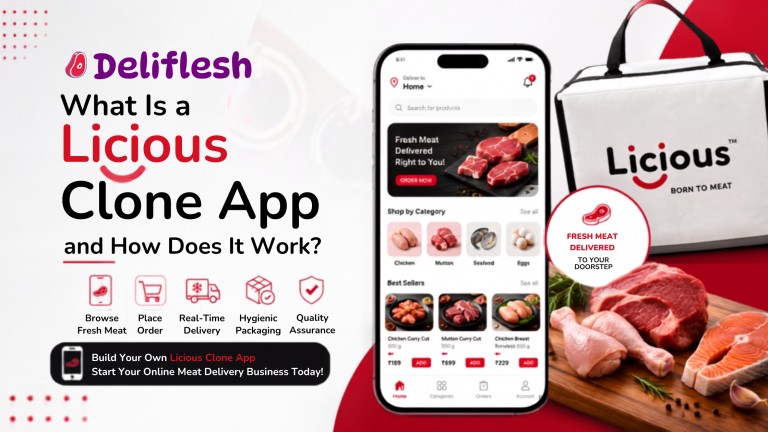
What Is a Licious Clone App and How Does It Work?
Updated July 2026 · 10 min read · deliflesh.app
In short: A Licious clone is a ready-made, white-label software solution that replicates the core ordering, delivery, and admin workflow of the popular meat and seafood delivery app Licious. It lets entrepreneurs launch their own branded meat delivery business quickly, without building the technology from scratch.
The online meat and seafood category is no longer a niche corner of grocery delivery. In fact, the global meat market is set to reach USD 1.3 trillion in 2026. According to Grand View Research the broader meat, poultry, and seafood segment has seen a rise in home delivery models becoming a genuine growth driver for the category, with Licious itself cited as a standout example of this shift. So, if you are exploring this space, getting a clear picture of what a Licious clone is, and how it functions, is the right first step.
What Is a Licious Clone App?
A Licious clone is essentially a pre-built meat delivery app script modeled after Licious’s farm-to-fork approach. Instead of spending months coding a platform, you get a functional, customizable base that already includes the ordering logic, delivery workflow, and admin controls Licious itself uses.
Here’s what typically makes up the package:
- Customer app for browsing, ordering, and tracking meat and seafood products
- Delivery partner app for accepting, managing, and completing orders
- Vendor or meat shop app for inventory and order management
- Admin panel to oversee the entire operation
Because the foundation is already tested, this on-demand meat delivery app clone approach cuts both development time and risk considerably compared to building from zero.
How Does a Licious Clone App Work?
Understanding the mechanics helps you see why this model launches so much faster than custom development. Here’s the typical flow, step by step:
- Customer places an order – through the mobile app or website, filtered by product type, cut, or quantity
- Order routes to the nearest vendor – using location-based logic similar to hyperlocal grocery apps
- Vendor confirms and prepares the order – chilled, never frozen, matching the farm-to-fork promise
- Delivery partner is assigned – automatically, based on proximity and availability
- Real-time tracking begins – customers watch their order move from shop to doorstep
- Payment settles and order closes – with automated commission splits between vendor, delivery partner, and platform owner
Consequently, every stakeholder, customer, vendor, delivery partner, and business owner, interacts through one connected system. This is the operational backbone that makes a Licious clone function like the original app.
Core Modules Compared
| Module | Primary Function | Key Feature |
| Customer App | Browsing and ordering | Category filters, live tracking |
| Delivery App | Order fulfillment | Route optimization, earnings dashboard |
| Vendor App | Inventory management | Stock alerts, order acceptance |
| Admin Panel | Business oversight | Analytics, commission control, user management |
Why Businesses Choose the Clone Model Over Custom Build
Building from scratch is possible, but most founders prefer the clone route for practical reasons:
- Faster launch – go live in weeks instead of months
- Lower initial investment – validate the market before committing large capital
- Proven workflow – the logic already mirrors a business with real traction
- Easier scaling – most scripts are modular, so new features slot in later
However, it’s worth noting that a clone isn’t a copy-paste shortcut. The best platforms are fully customizable, meaning your branding, pricing logic, and regional features can still be entirely your own. If you’re weighing this decision in more detail, our guide on white label meat delivery app script benefits breaks down the advantages further.
Key Features to Look For
Not every meat delivery app script on the market is built the same way. Before choosing a provider, check for:
- Multi-vendor or single-vendor flexibility
- Cold-chain-friendly order handling (temperature and freshness alerts)
- Multiple payment gateway support
- Subscription or repeat-order options
- Multi-language and multi-currency support for regional or global launches
Furthermore, a strong admin dashboard with real-time analytics separates a genuinely useful clone from a barebones one. For a closer look at evaluating providers, check our guide on how to pick the best meat delivery app script.
Who Should Consider a Licious Clone?
This model fits a range of founders, not just direct Licious competitors:
- Local butchers looking to digitize their existing customer base
- Grocery entrepreneurs wanting to add a high-margin meat and seafood vertical
- Regional startups aiming to replicate a proven farm-to-fork model in an underserved market
- Existing delivery businesses expanding into a specialized on-demand meat delivery app clone offering
Conclusion
A Licious clone gives you a tested, ready-to-launch foundation for a meat and seafood delivery business, without the time and risk of building everything from the ground up. From order routing to real-time tracking and vendor management, the entire workflow mirrors a model that already works at scale. Whether you’re a local butcher going digital or an entrepreneur eyeing a fast-growing category, the right clone platform can get you from idea to launch in weeks, not months.
Ready to see it up close?
Take a look at the live demo of Deliflesh, or book a free consultation call with our team and walk away with a clear plan for launching your own Licious clone.
Frequently Asked Questions
1. Is a Licious clone legal to use?
Yes. A clone script is original software built to replicate app functionality, not Licious’s actual code or brand assets, so using it under your own name and branding is legal.
2. How long does it take to launch a Licious clone?
Most white-label scripts can go live within 2 to 4 weeks, depending on how much customization you need.
3. Can a Licious clone support multiple vendors?
Yes. Many scripts support both single-vendor and multi-vendor models, so you can choose the structure that fits your supply chain.
4. Does a Licious clone include a delivery partner app?
A complete package should include a customer app, delivery partner app, vendor app, and admin panel. Always confirm this before purchasing.
5. Can I customize the app after launch?
Yes. A good meat delivery app script is modular, letting you add features like subscriptions or loyalty programs as your business grows.
